
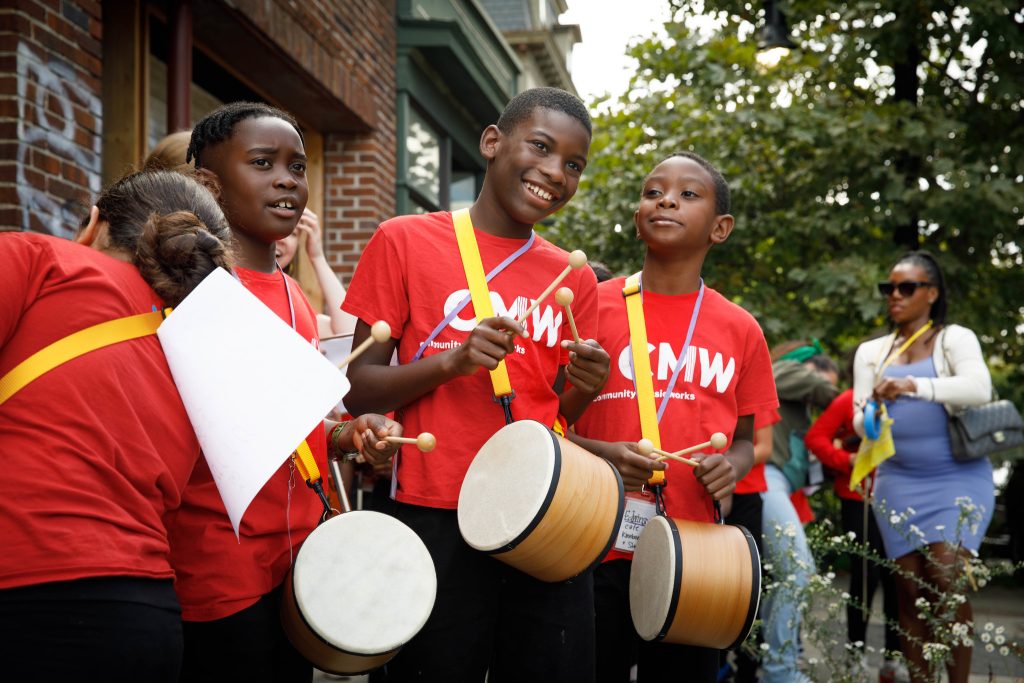
On a recent Saturday, a group of grade-school aged children wearing red t-shirts lined up on the sidewalk on Westminster Street in the West End of Providence. They were outside of two empty storefronts that used to hold Community MusicWorks. The youngest children were at the front carrying small drums and mallets. They were followed by older children with violins and violas. After a bit of bustling, they started playing and walking down the street.
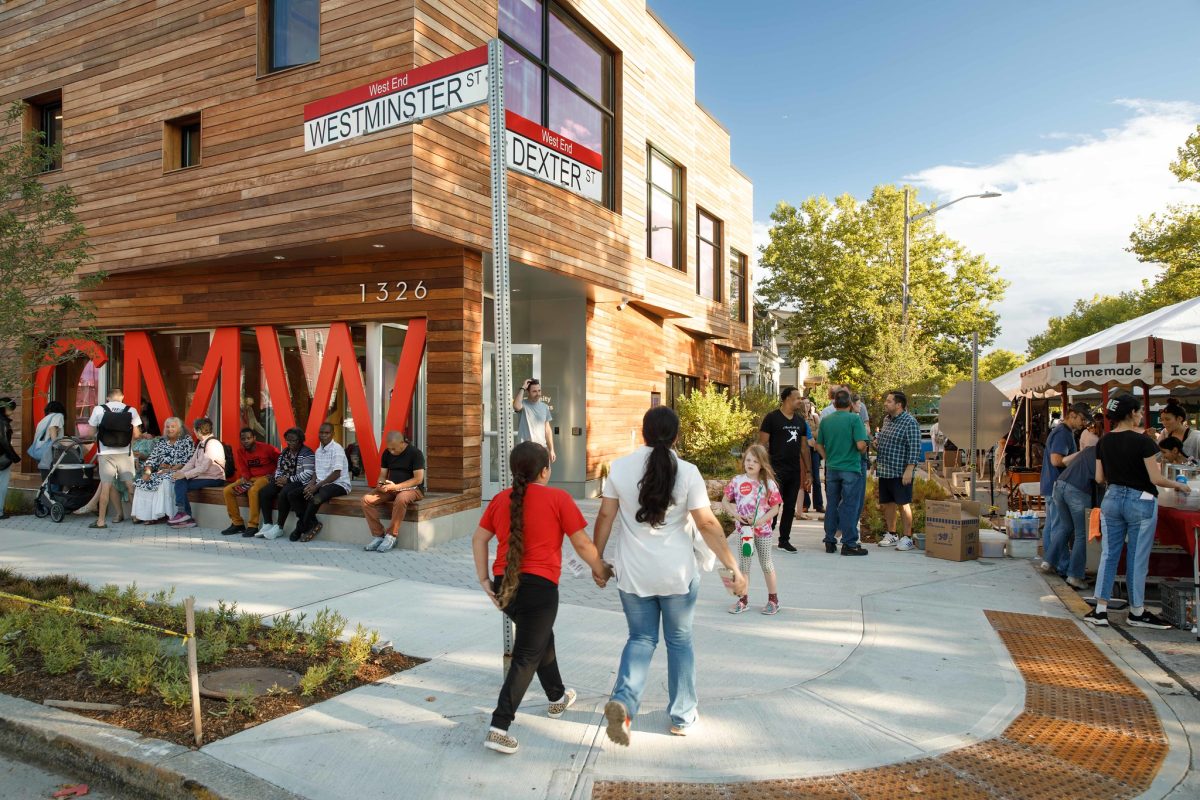
The children had music taped to their backs so the next child behind them could read the score. They slowly made their way about two blocks down the street, to a new, two-story wood-clad building at the corner of Westminster and Dexter. The processional was part of the opening celebration for the new home of Community MusicWorks – a non-profit that uses music education and performance as a way of building community.
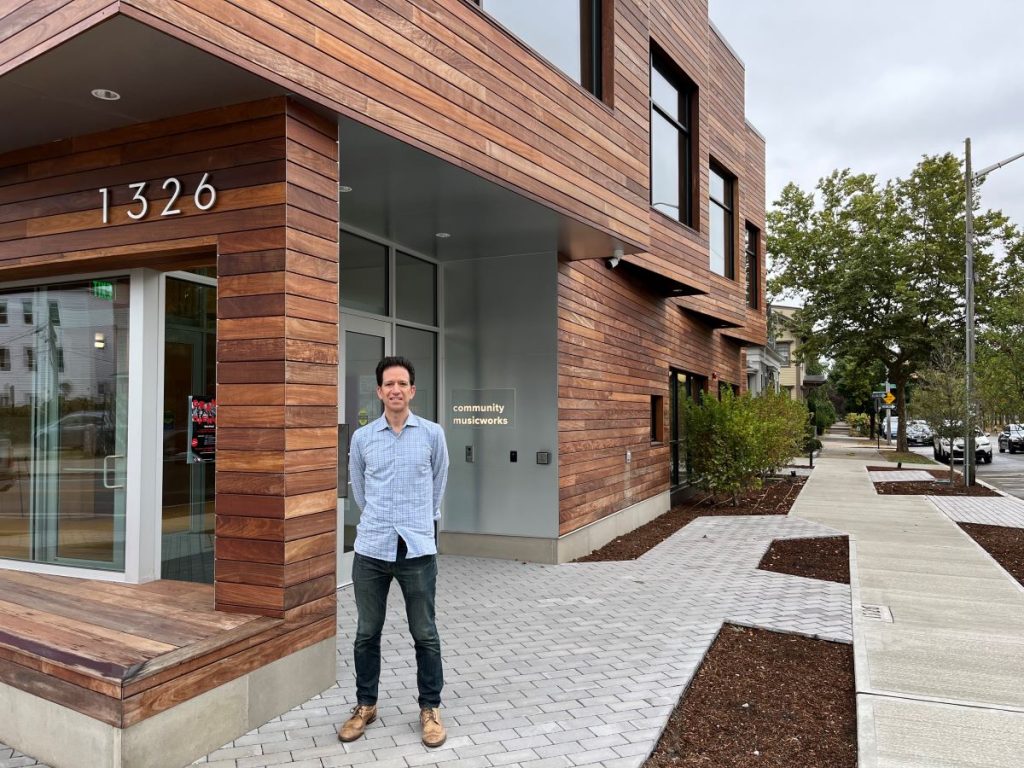
Sebastian Ruth started Community Music Works in 1997 and is the organization’s Artistic Director. “For 20 plus years, we had our headquarters down the street of Westminster at 1390 Westminster,” he said, “which in the beginning was just one little storefront. That was teaching, that was rehearsals, that was meetings, that was little performances, and eventually we grew into the second storefront and that Victorian house. And eventually into the third floor and into the rest of that building over time.”
CMW started with just 15 students and now serves up to 150 young people per year. And although they took over that entire old house, it wasn’t enough room for everything they wanted to do. Instead, they had some of their programs in various community centers, schools and they held performances in area churches.
“But that nomadic quality had its definite upsides and it also had the downside of not having a center where families and young people could really come together, and be in community,” Rush said. “So, many years ago, I started thinking, ‘what would a space for this organization look like?’ And eventually came to this idea of a center where all things could happen under one roof, not to the exclusion of still being nomadic and showing up in different community spaces, which we still intend to do, but a way to, really have a community center around music.”
After years of planning and community meetings, and three years of construction, the new Community MusicWorks Center opened with a block party and concert in late September. Abraham is a 10th grader who has been going to CMW for about 5 years. He said that it looks deceptively small from the outside, ”but when you go in, there’s like so many rooms, so many places. You can do a lot, you can practice, do your work, hang out with other friends and stuff, and I feel like that’s a really good aspect of the place.”
The CMW Center has a few rehearsal rooms for various ensembles, rooms that are designed for teachers to have one-on-one lessons with students, and several small rooms for students to practice on their own.
Abigail, who plays cello and has been involved with CMW for eight years, appreciates how the new building has more space. “We have so many lesson rooms and we have practice rooms,” she said. “It’s just so much space for people to all be there at once. It doesn’t have to be like just four or five people in the building.”
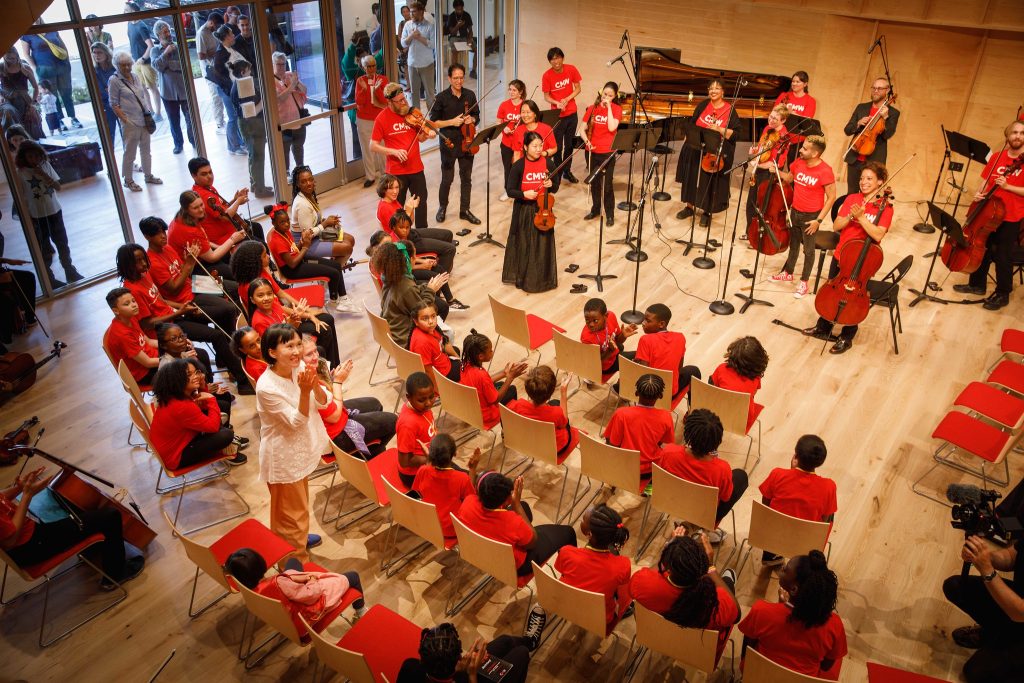
The performance hall takes up two levels at the center of the building. It’s designed to hold an audience of 120 along with an ensemble of about 8-12 musicians. It has a flat floor and it’s completely clad in wood. Sebastian Ruth gave me a tour a few days before the opening party, pointing out the features of the hall.
“There’s various angles of the wood that were very precisely designed to have the right proportions of resonance and, and reverberance, but also focus,” he said. “So it’s a very exciting prospect to be thinking about playing concerts in here. And also other community events so that you can clear all the chairs, you can dance in here, you can have a meeting in here. But, for music it’s very special.”
There are wood surfaces throughout the CMW Center. In fact, the main structure is wood instead of steel. “And it’s only the second building that we know of in Rhode Island to use mass timber as the structure,” Ruth added.
“There’s been a huge priority to minimize any VOCs, any toxins from the building. The architects worked with the Healthy Materials Lab at Parsons in New York to evaluate every material that was going into the building through the whole life cycle, manufacture, human exposure during, while people were with it and disposal. But principally, like what’s healthy for children to be around? And let’s minimize things that are known to have health hazards for children. So the paint on the walls is not a latex paint. There’s no plastics in the paint. All the carpets are free of some of the stained guards and other things that can make that unhealthy. The furniture selection, everything was thought through a material perspective.”
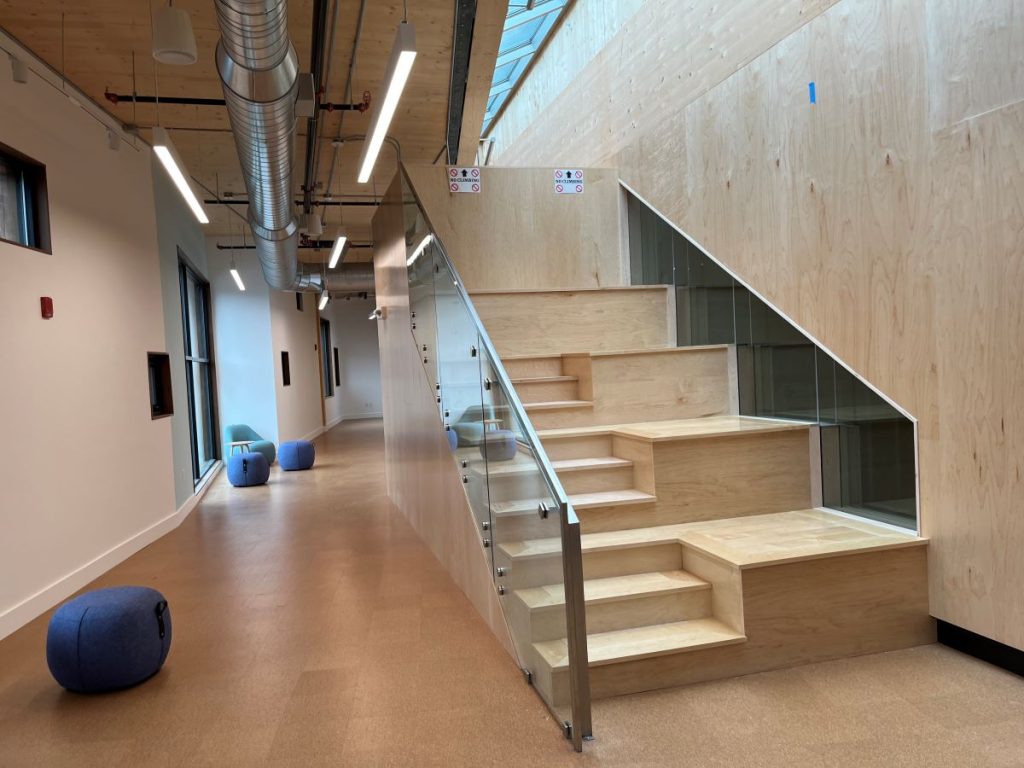
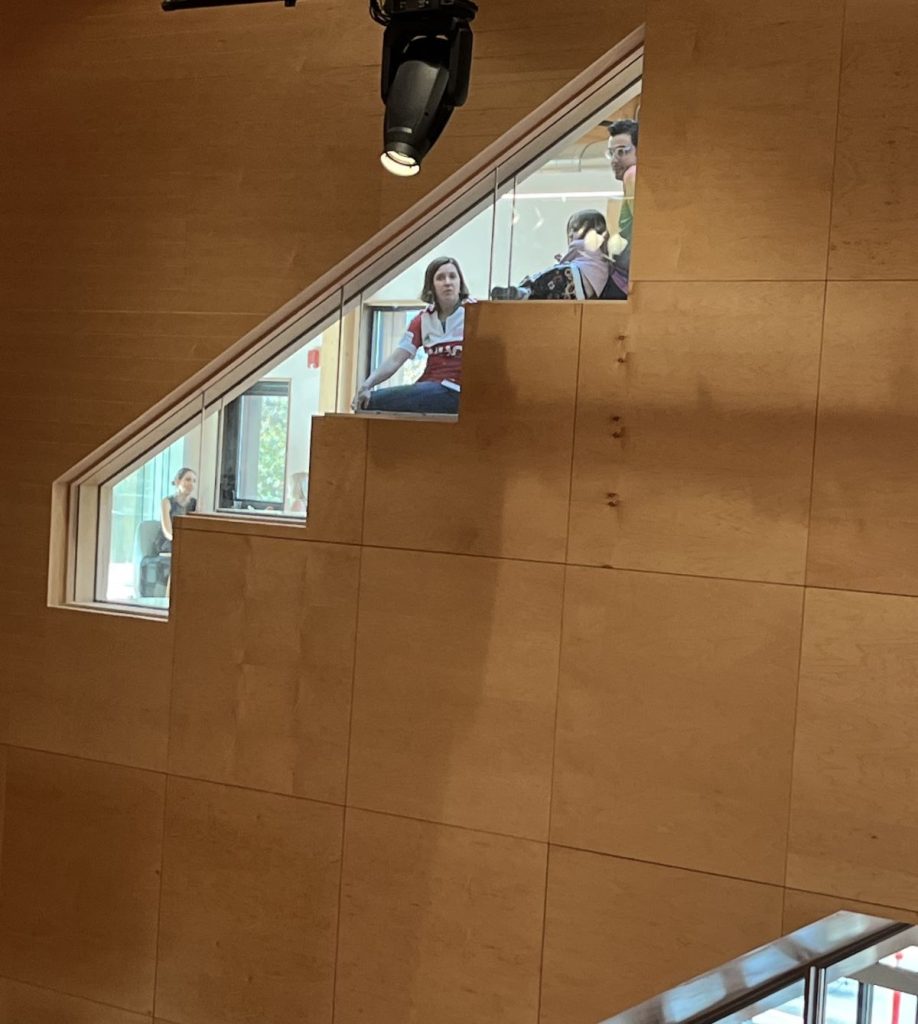
Most of the spaces in the Community MusicWorks Center are designed for making music. But some of the most interesting spaces are something else. There’s a cafe that should be open to the public next year for breakfast and lunch. There’s a student lounge with a set of wooden steps on the second floor that don’t go anywhere, but are designed for students to gather and look into the performance hall.
The hall itself is set at an angle compared to the exterior of the building and this allows for little angled benches at several points along the inside hallways – creating more informal space for students to gather. And there’s huge windows letting in natural light, everywhere. There’s a skylight in the student lounge on the second floor, which has a glass floor that allows the light to filter down to the cafe area, which is open to the lower level where the practice rooms are.
Doris De Los Santos is on the board for CMW and is the parent of two children who have gone through the program. She appreciates how the architecture of the center makes it feel open to the community.
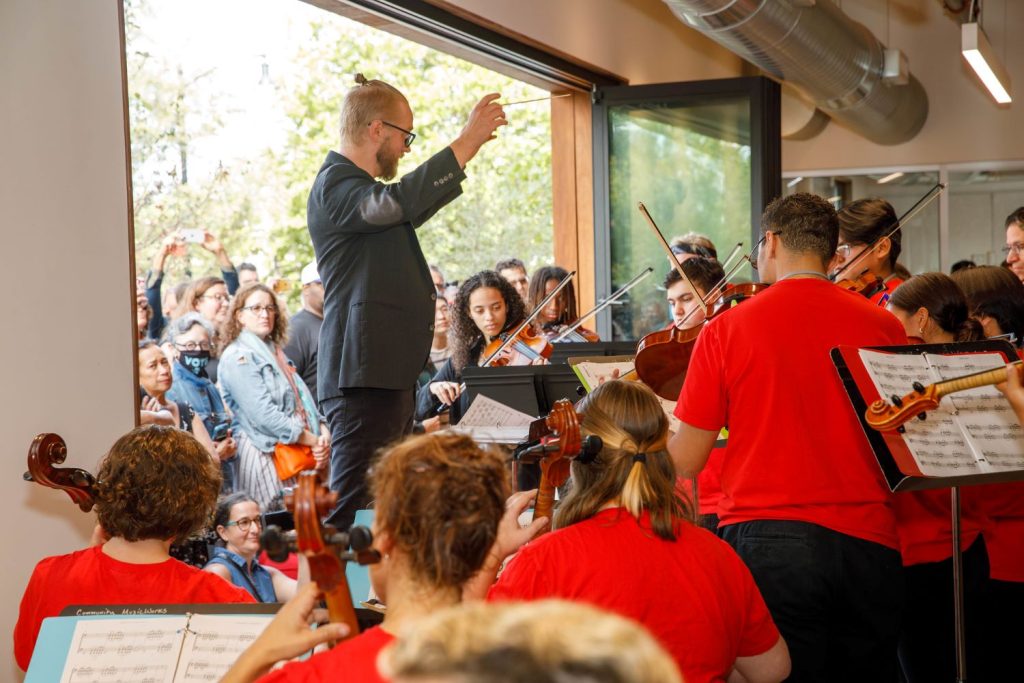
“The fact that the main performance floor is an extension of the sidewalk and the street and the community,” she said, pointing out the giant glass doors that open directly onto the sidewalk and the windows into the performance hall that can be seen from the street. “The fact that people are walking by, pedestrians can just be walking by and a performance may be happening inside the sidewalk. Sound is perfect, right? Because all the details were taken care of. But the glass allows the light and the people and the energy and the vibrancy of the neighborhood to just come together.”
“It is a place where kids come to learn to play music,” she added, “but it’s so much, so more than that, right? It’s about how do we become citizens of the communities that we inhabit? It is about becoming in tune with what is being socially responsible. It’s about having civil discourse. It’s about how they see themselves, the students, as agents of change. And of course, it’s also about music.”
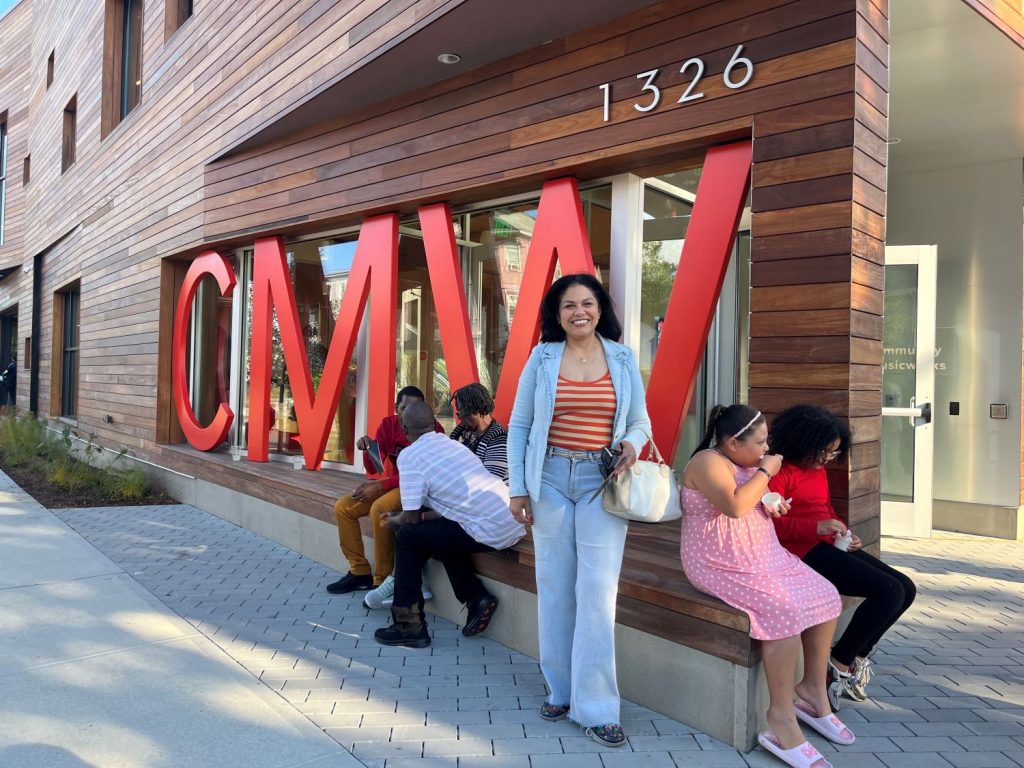
The building is a hands-down success by the designers, 3SIXØ Architecture. It’s a beautiful place to make music and to hear music, and it’s a place for people to gather. But now that Community MusicWorks is in a fancy new building, will Sebastian Ruth miss anything about working in those storefronts down the street?
“I think one thing that we need to hold onto from the old space is the informality and the sort of delightful disjunction of walking down the street and seeing what used to be a fruit seller and now it’s a string quartet rehearsing. Or you pass the corner store and the little restaurant and then a violin lesson and just the way that that storefront enabled us to be part of the fabric of a thoroughfare in the West End, right? The new building could look a little glossy because it’s so beautiful and new. But at the same time, the DNA is still there. And the architecture supports this kind of passerby experience. And we hope that people feel, and I think we’re already starting to see that the door is always open.” You can enjoy a concert at the CMW Center next Thursday at 7 p.m. It’s their first “Sonata Series” in their new home. They’ll play works by Janáček, Debussy and more.