

When Hamas attacked Israel last October 7th, it raised concerns about a wider conflict in the Middle East. This week, Iran fired more than 180 missiles into Israel, in response to Israel’s assassination of the head of Hezbollah. The question now is how Israel will respond … and whether the Middle East can step back from the brink of an intensifying war.
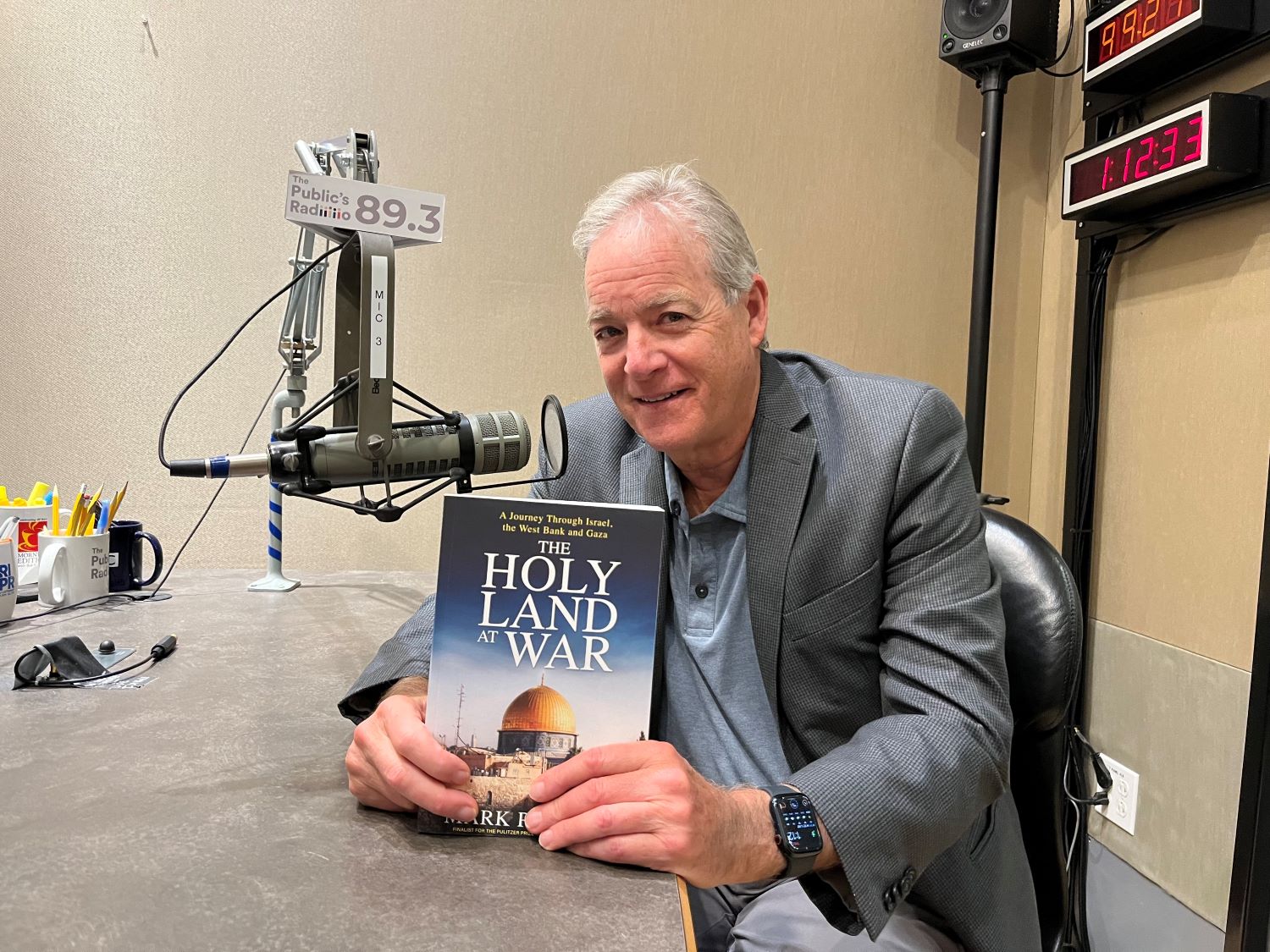
Providence Journal columnist Mark Patinkin is no stranger to the region. He traveled to the Middle East after the first intifada in the late 80s and returned this year. His conversations with Israelis and Palestinians became part of Patinkin’s latest book, “The Holy Land at War: A Journey Through the West Bank, Israel and Gaza.” Patinkin has been a columnist at the ProJo since 1979. Forty-five years later, he’s still at it, writing with a mix of humor and outrage about different aspects of life in Rhode Island. So how does Pantinkin view the outlook for stepping back from the precipice of wider violence in the Middle East? Does he think Rhode Island politicians are up to the task of building a stronger economy? And how does the longtime columnist feel about the evolving media landscape in the state? This week on Political Roundtable, I’m going in-depth with columnist for The Providence Journal Mark Patinkin.
This transcript has been edited for clarity.
Ian Donnis: Welcome to The Public’s Radio.
Mark Patinkin: Great to be here, Ian.
Donnis: Mark, we’re going to talk in depth about the Middle East, but I want to start with a few questions about Rhode Island’s economy, because you’ve been following this for a long time. You wrote some hard edged columns about how, in your view, state officials fell down by letting the Paw Sox get away to Worcester, and in particular, you blame former House Speaker Nicholas Mattiello. Now we see how Hasbro is contemplating leaving Rhode Island. CVS is looking at a major reorganization. I wonder if you think state politicians are up to the task of retaining major employers and building a better economy.
Patinkin: Yeah, I think fell down on the job as putting it mildly. I think Mattiello and the state house in particular, that’s one of the great moments of shame in Rhode Island government history, that they basically pushed the Paw Sox over. And I would lay it so much on Mattiello that I would say I have more hope because I think [Joe] Shekarchi is a completely different kind of speaker. And he’s already engaged, which Mattiello never was with the boss. Like he’s already engaged talking to Hasbro, and so I think he’s a lot more enlightened. So I have a little bit more hope about that, but I think the politicians have to really show some love. You know, there was this episode with the Paw Sox where Worcester was showing them love and we just took them for granted. We can’t do that. And I think that also, in terms of Hasbro, I think the reality is they’re probably not going to stay in Pawtucket. So I would think the focus should be on finding a great place in Providence that would work for Hasbro as well as Rhode Island.
Donnis: On a related note, you published a book in 1989 with Ira Magaziner. father of Congressman Seth Magaziner, and he would go on to be an aide to Bill Clinton about how global business battles were shaping America’s future. That was before NAFTA and deindustrialization that has eliminated a lot of good manufacturing jobs. Can we see that as anything other than a failure by politicians?
Patinkin: Well, there are global forces at work, but what we found, Ira and I, and Ira was really the, this was something he was a pioneer of, he really looked closely at how business competitiveness is tied to nations’ business policies and that many foreign governments were supporting business in ways we weren’t. You don’t want to go overboard, with industrial policy picking winners and losers, but I think it’s very important for governments to be mindful of how to keep businesses in the same way we’re talking about how to keep Hasbro. It should be done on a national basis with really hyper focusing on industries and even companies that are under threat of losing, of moving.
Donnis: Well, let’s turn our attention to your book, “The Holy Land at War.” We see now how all eyes are on Israel and how it will respond to a missile attack by Iran. Do you think anything can be done to avoid a wider war at this point?
Patinkin: It’s a great question. I think Israel will respond. That’s Israel’s mentality. Israel has realized they’re in a tough neighborhood with neighbors that want to wipe it off the map. It’s really that simple. And when you go there, as I went there, you see how deep that mentality is. You see there’s still a little bit of a Holocaust mentality there, where, they’re aware that through history, for millennia, for thousands of years, When Jews were under threat, if they were helpless, if they weren’t able to defend themselves, if they weren’t able to fight back, they were literally wiped out. I mean, history shows a case of genocide of Jews and they have the mentality that finally, finally we can fight back and they feel that the only way to give a message is to do so. I think they will respond to Iran. Will there be a wider war? I think it depends on whether Iran will continue to counterattack. I think that’d be a huge mistake. I think the Israelis are much more capable than the Iranians of causing massive destruction against their enemy.
Donnis: As you say, Israel has a very impressive military, but that has not helped to create peace in the Middle East for decades. From your travels this year for your book, The Holy Land at War, did any of your conversations with Israelis and Palestinians shed light on what it would take to bring about a more peaceful future?
Patinkin: I think the simple answer they would give would be for Palestinians to focus on building up the territories where they are instead of trying to attack Israel and come back. There’s a deep mentality in Palestinians that I found, because I spent a lot of time, it’s a very well balanced book. I spent a lot of time, it’s the only Palestinian face I saw on the West Bank, and that was, they were very welcoming. I was in several Palestinian homes. They bring chicken, they bring coffee. They were very honored to have me, an American journalist, present. But I do notice that there is a tendency to live in the past on the part of Palestinians. It’s part of the culture that they live in the past. Some of them have keys to homes that they say they had before the 1948 war that saw the founding of Israel. And they look back towards that. Instead of building on where they are, they look back towards reclaiming what they once claim they had. And so I did find that, that it’s a backward looking culture and mentality in terms of that, and I think we have to remember, I was in Gaza itself, too, in the midst of the, in the midst of the very war, where explosions were going off so close that smoke swept over us 30 seconds, later, and I think you gotta remember that they did have, Israelis left in 2005. They had Gaza to themselves, and they did, there’s no way around it, focus too much on building tunnels instead of building what could have been, some people say it could have been Singapore, I don’t know if that’s overstated, but it’s a beautiful piece of land and they didn’t focus on building it up.
Donnis: What do you make of the dichotomy between how the American political establishment remains staunchly behind Israel? And on the other hand, we see how student activists at Brown and many other universities are much more concerned with the plight of the Palestinians?
Patinkin: Yeah, I’d say interesting to see that the, that generation, has really embraced the Palestinian cause. I think there’s, certainly, look, there’s some grounds to claim Israel has overstepped and I saw some of that too when I was in the West Bank. I spent a day with a Palestinian teacher, a really wonderful guy who is struggling. Even the moderate Palestinians like this gentleman, his name was Omar, has three kids, a wife who’s pregnant. He’s struggling. He’s a teacher. The Israelis have cut off their tax remittances to the Palestinian Authority and the West Bank. His salary has been cut in half. He’s completely struggling and he has a little village, he lives in a village right outside of Bethlehem, which some people think Bethlehem’s like right in the heart of, right next to the Western Wall and the Church of the Holy Sepulchre in Jerusalem. It’s like deep in the West Bank. And as we drove from Bethlehem to his nearby village, we drove past many Jewish settlements, white buildings that were mostly walled off. And he used an Arabic word to explain what’s happening, “Shway shway.” “Little bit, little bit.” That’s how those Jewish settlements are spreading. And I saw with my own eyes how that, there’s room for Jews, I think, to live on the West Bank. But there’s areas where it’s going overboard, and college students have focused on where it’s going overboard. and there’s a legitimate conversation to be had about that, but I think there’s a real blindness on the part of the most adamant college protestors to the kind of siege Israel has been under. To the horrific attack of October 7th, and, I think there’s a blindness to how Israel, if they don’t hold their own and they don’t fight back, they will be wiped out because the surrounding countries and the Palestinian groups like Hamas would not stop.
Donnis: I’d like to change gears and ask you a question about your esteemed employer, the Providence Journal. I’m a long time subscriber. I think the journal still offers a lot of tremendous reporting and commentary by yourself, Kathy Gregg, Patrick Anderson, Antonia Farzan, and a number of other talented people. But The ProJo, a lot of people talk about how it, like many newspapers, is much thinner and has a far smaller staff than in the past. What is your response to that when people talk in that way?
Patinkin: Well, it’s called the internet. It’s completely changed media in America. There’s no way around it. There never was, this thing called Google before and Facebook before, and they’ve grabbed billions of dollars of ad money. Look, the bottom line is there’s, probably a third of the ad money coming in, third of the revenue from subscribers and et cetera coming in to newspapers than there used to be. People consume news differently and it’s just a, it’s a change. But I would say that the Providence Journal is still the big dog in town, though there’s, you guys are right there too. The Public’s Radio, I think, is an amazing journalism force, and there are, the TV stations are good, and look, I’ll even say it, the Boston Globe has a good team here. It’s a very, I think, energetic journalism environment, I think the, Rhode Island is lucky to have a great group of journalists here in the state, but I would argue that the Providence Journal, it’s not as big as it was, but we are scrappy. There are enormously talented reporters there, many of them newer, and I think we do, really well. I think we’re doing an amazing job with a scrappy team.
Donnis: Our mutual friend Dante Bellini did a terrific documentary about your scare with kidney cancer that was identified kind of due to a chance encounter. Tell us about that.
Patinkin: Well, it was. I just had pain in my side that was from actually a kidney stone. Never had one before, never had one since. And, if it hadn’t been for that, I’m not sure I would be sitting here today. And so, it makes, you kind of believe in grace. The film that Dante Bellini did, and I’m actually writing and finishing a book on it too, is really told through the eyes of the caregivers from the ultrasound tech that found the cancer to the surgeon who removed it under difficult circumstances. A real testament to the health care industry here.
Donnis: We’ve got to leave it there. Mark Patinkin, Providence Journal columnist and author most recently of “The Holy Land at War.” Thank you so much for joining us.
Patinkin: Great to be here, Ian.
– – –
As Rhode Island and other states try to chip away at the housing crisis, one idea gaining more currency is to build more housing near public transit. You can read more about that in my TGIF column, posting around 4 this afternoon at thepublicsradio.org/tgif and on what used to be known as Twitter @IanDon.
That’s it for our show. Political Roundtable is a production of The Public’s Radio. Our producer is James Baumgartner. I’m Ian Donnis, and I’ll see you on the radio.
Election 2024 coverage on The Public’s Radio is sponsored in part by Ascent Audiology & Hearing, by Providence Picture Frames, and by Rustigian Rugs.
