

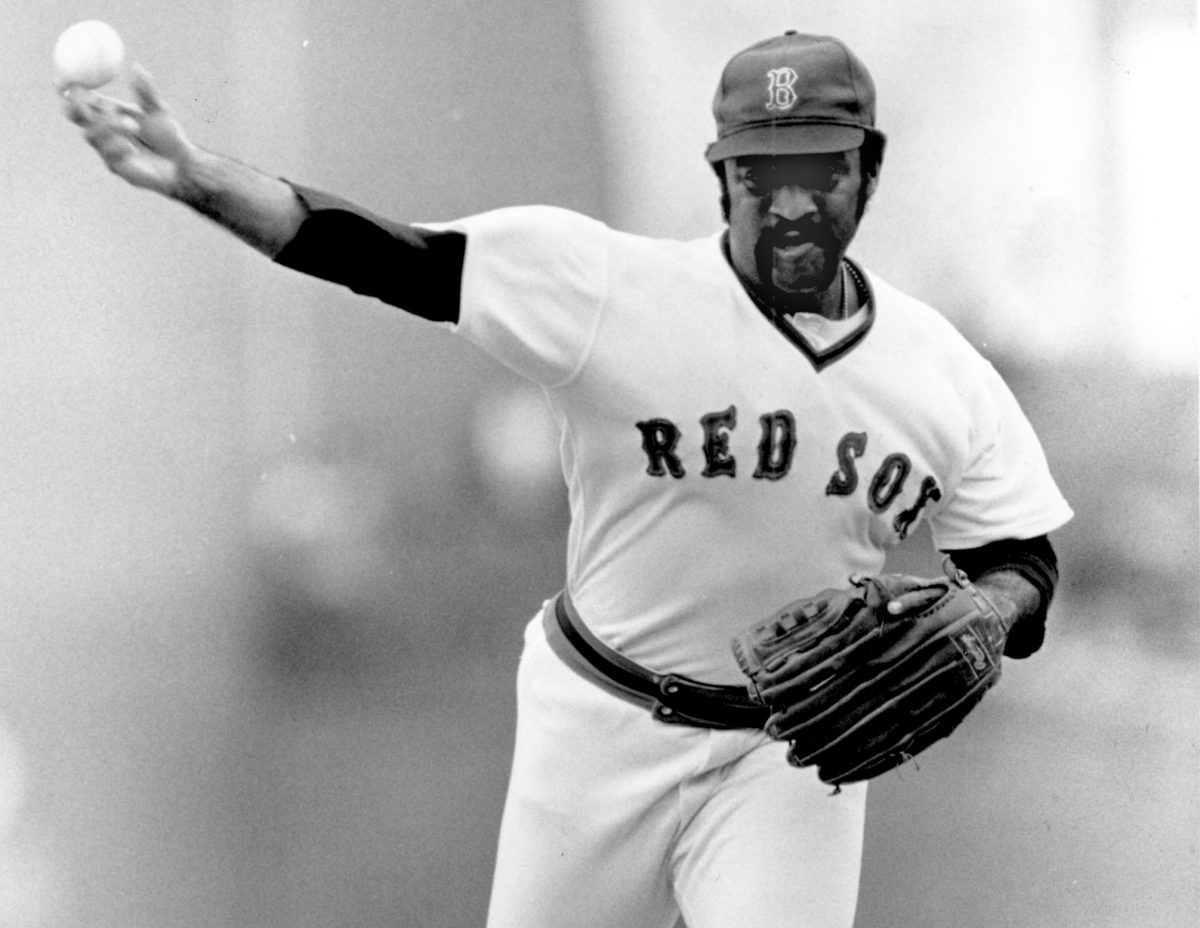
He was a big-time pitcher with a big-time personality. His one-of-a-kind windup defied description. His delivery baffled hitters. His ever-smoldering cigar became a facial feature. Opponents respected him; teammates and fans loved him.
Luis Tiant died Tuesday at his home in Maine. He was 83.
El Tiante, as we dubbed him, was an icon in New England, the pitching star of the power hitting 1970s Red Sox. He helped define an era of spectacular but ultimately disappointing seasons that failed to end the suffering of Red Sox Nation. Boston’s last World Series Championship had occurred in 1918.
He arrived in Boston in 1971 after six decent years in Cleveland (75-64) and one season in Minnesota (7-3). He was 1-7 in his first year with the Red Sox, but from 1972 through 1978 he was an ace — his eight-year total with Boston 122-81. He won 86 games from 1973 through 1976.
Most impressive of his career stats: 187 complete games in 484 starts. That’s 38 percent! We’ll never see that again in this age of analytics and five-inning starts.
Wait! I take that back. Most impressive about Luis Tiant was that windup, one of the weirdest in baseball history.
Standing on the rubber, hands at his belt buckle, glove shielding his right hand clutching the ball, Tiant would face catcher Carlton Fisk for the sign. Then he would sweep his hands up just above his cap, twist his torso so he was facing second base, raise his left leg so his knee was at a 90-degree angle, and present the numeral 23 on the back of his jersey to the batter. Next, he would dip his chin, spin around quickly and deliver his pitch.
Overhand, three-quarters, sidearm. Seldom the same consecutive delivery. A sneaky fastball up and in. A big looping changeup. A breaking ball on the outside corner. He had four pitches he could throw for strikes, but that motion alone kept hitters off balance and guessing. Check it out on YouTube.
The late, great Roger Angell described Tiant’s style perfectly and poetically in his 1977 classic Five Seasons:
“His repertoire begins with an exaggerated mid-windup pivot, during which he turns his back to the batter and seems to examine the infield directly behind the mound for signs of crabgrass. With men on bases, his stretch consists of a succession of minute downward waggles and pauses of the glove, and a menacing sidewise, slit-eyed, Valentino-like gaze over his shoulder at the base runner. The full flower of his art, however, comes during the actual delivery, which is executed with a perfect variety show of accompanying gestures and impersonations.”
Angell’s descriptive prose continued for another half page.
El Tiante’s story transcends wins and losses. His father, also Luis, was a great pitcher in Cuba and in the Negro Leagues in the U.S. Locals joked that Luis the elder was a better pitcher than his famous son.
The son immigrated to the U.S. in 1961, knowing that he might never see his homeland or his parents again. Cuban President Fidel Castro had said that any Cuban who left to play baseball could not return.
Tiant was a stocky man listed at 6 feet and 180 pounds. He wore a droopy mustache and the long sideburns stylish in the ‘70s. He loved his cigars and smoked them everywhere, including the Red Sox clubhouse and training room — even while soaking in a whirlpool tub. Probably the only times he wasn’t puffing were when he was asleep and on the mound.
Luis Tiant lived to pitch in big games. Carl Yastrzemski once said: “If you wanted one pitcher to start a big game, it would be Luis Tiant. Nobody was a tougher competitor or a better teammate.”
In 1975, Tiant started the first game of the American League Championship Series against the Oakland A’s. He went the distance, allowed three hits and struck out eight in Boston’s 7-1 victory. The Red Sox swept the A’s in three games.
Tiant started the first game of the World Series against Cincinnati’s Big Red Machine. He went nine innings again, scattered five hits, struck out three and walked two intentionally in the 6-0 Red Sox victory. The packed house chanted “Loo-ie! Loo-ie!” His parents were in the stands, thanks to the diplomatic efforts of Massachusetts Senators Ted Kennedy and Ed Brooke. Yes, Democrats and Republicans cooperated in those days.
In Game Four at Riverfront Stadium — the Reds led the Series 2-1 and the Red Sox needed a victory to ensure a return to Fenway Park — Tiant started and went nine innings again as the Sox prevailed, 5-4. He allowed nine hits, walked four, struck out four and threw 155 pitches — that’s right, 155 pitches, 87 for strikes!
Thanks to three days of rain, Tiant took the mound one more time for Game Six, arguably the most exciting in World Series history. His tank finally ran dry in the eighth inning. Cesar Geronimo led off with a home run, and Tiant gave way to Roger Moret. He had allowed six runs on 11 hits, walked two, struck out five and had thrown 113 pitches, 71 for strikes. He sat down with the Sox trailing, 6-3.
But Bernie Carbo tied it with a pinch-hit three-run homer into the bleachers in center in the bottom of the eighth. Carlton Fisk ended it with his dramatic 12th-inning waved-fair home run off the left-field foul pole.
Here’s another. In 1978 the Red Sox blew a 14 1/2 game lead in the AL East and had to win their regular-season finale to force a one-game playoff against the Yankees. On Oct. 1, El Tiante threw a two-hit shutout against the Toronto Blue Jays. The Red Sox won. We all know what happened on Oct. 2. Does Bucky Dent jog your memory?
I wrote about those 1975 games for The Woonsocket Call. I was 25 years old and had been promoted to sports editor in mid-September. Two weeks later I was sitting in the auxiliary press box — the old sky-view seats high above the third-base line — at Fenway Park. I couldn’t believe it. A decade earlier I was going to games with my father and brothers. Now I was covering them, going into the clubhouse with writers from The Boston Globe, the Herald, the Record-American and suburban dailies to interview Yaz, Fisk, Rico Petrocelli, Denny Doyle, Rick Burleson, Dwight Evans, Fred Lynn and Luis Tiant.
Almost 50 years later I still shake my head in disbelief at my good fortune.
Stories of Tiant’s charisma abound on social media.
A fan recalled a 1977 game when he and about 50 other kids, hoping to catch a glimpse of their heroes leaving Fenway, gathered outside the Red Sox parking lot. Tiant drove his white Cadillac through the gate, parked about 20 feet away and signed an autograph for every one of them.
Another told of seeing Tiant about eight years ago in a restaurant takeout line in Maine. The man’s 8-year-old son was wearing a Red Sox shirt. Tiant called him over and asked the man’s 10-year-old daughter to “take a picture of me and my buddy.”
A neighbor recalled Tiant cutting his own lawn at his home in suburban Milton.
A coach wrote that Tiant would park his car beyond left field so he wouldn’t be a distraction for his Little League son. So much cigar smoke drifted from the windows that the coach sometimes wondered if it were on fire.
In the wake of Tiant’s death, tributes appeared. This from Fred Lynn on X: “My friend and teammate, Luis Tiant, passed away. A Big game pitcher, a funny genuine guy who loved his family and baseball. I miss him already.”
Luis Tiant pitched for seven big-league teams during 19 seasons and compiled a record of 229-172. He was a three-time All-Star and MVP of the 1968 All-Star Game while pitching for the Cleveland Indians. He wrote a memoir, Son of Havana: A Baseball Journey from Cuba to the Big Leagues and Back, and was the subject of The Lost Son of Havana, a documentary filmed upon his return to Cuba after 46 years.
Does Tiant belong in the Baseball Hall of Fame? For what he accomplished in Boston in the 1970s, plus those three All-Star games and four 20-win seasons, yes. But baseball writers and the old timers committee squandered their opportunity to invite him to light up a big fat cigar in Cooperstown. El Tiante is in the Red Sox Hall of Fame. More important, though, he earned his place in our baseball hearts for his whirling heroics five decades ago.