

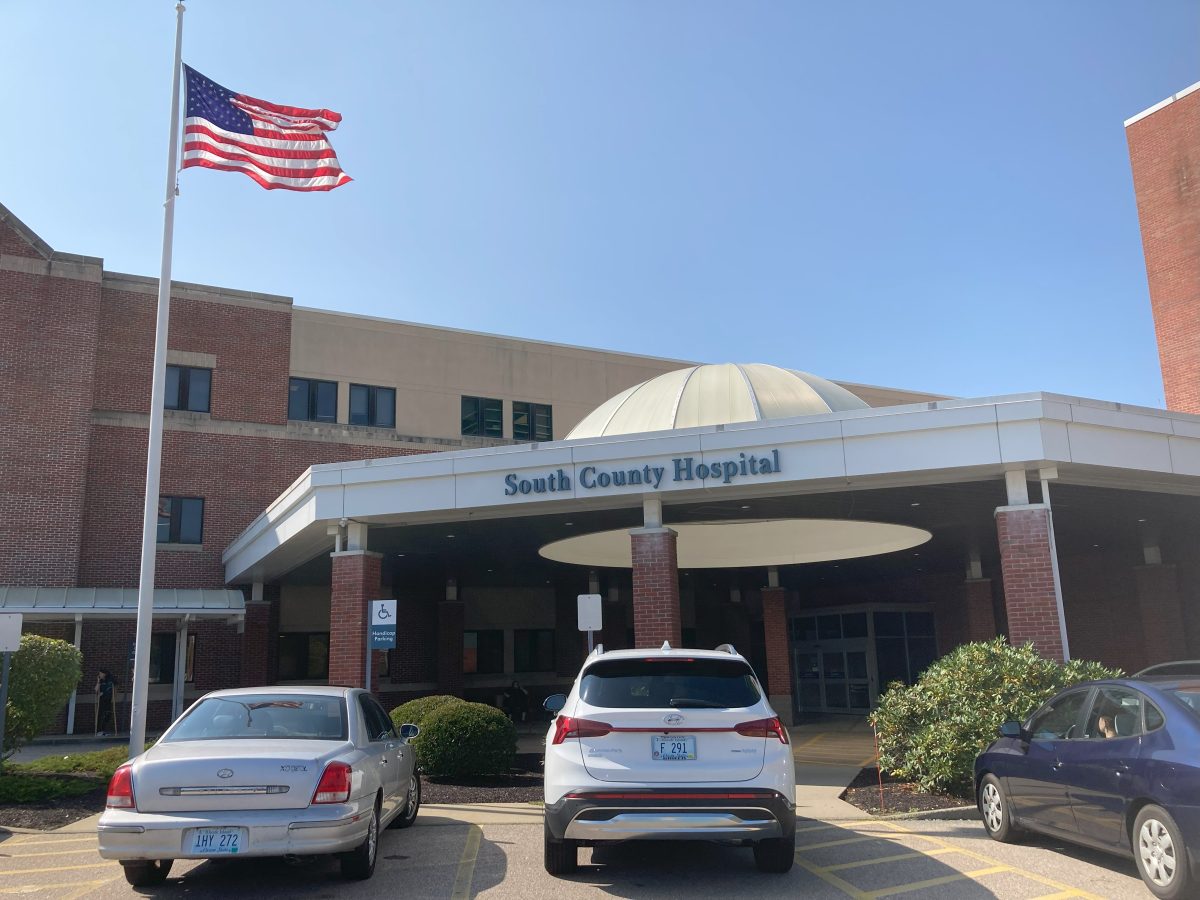
South County Hospital officials defending against accusations of mismanagement by a group of doctors have stressed that state and federal regulators recently found “no deficient practice” after a review at the hospital.
But state and federal regulators last year cited the 100-bed hospital in Wakefield for several “deficiencies,” including one of the highest severity, according to a review of inspection records since 2022 by The Public’s Radio.
Inspectors found that the hospital lacked proper documentation of patients transferred to other health care facilities, discharged a patient with an intravenous catheter still in the patient’s arm and gave another patient the wrong medication. The most severe deficiency involved a pregnant patient who accidentally received an excess infusion of Pitocin, a medication to induce labor, which inspectors said put the patient in immediate jeopardy of harm.
“Whenever a survey deficiency is found, South County Health rapidly responds with systematic process controls and mitigation efforts designed to immediately correct the deficiency and prevent potential harm,’’ the hospital’s parent, South County Health, said in an email.
The findings come to light as the hospital faces a mounting public outcry over the loss of a number of its longtime primary care clinicians and specialists in cardiology and oncology – and a cut back in services such as cardiac rehabilitation, hematology and lactation counseling.
The hospital also has reported roughly $6 million in operating losses for each of the past two years, according to the most recent audit report.
The community hospital serves residents of southern Rhode Island, and its parent, South County Health, operates independently of Rhode Island’s larger hospital systems.
The public outcry followed an open letter earlier this month from a group of doctors, nurses and community members to the hospital’s Board of Trustees and state officials, calling for leadership changes at the hospital. The letter said that management is driving clinicians to leave the hospital, eroding its future and quality of care.
South County Health’s board chairman, Joseph Matthews, and CEO Aaron Robinson, said in a statement last week concerns raised by the group are “misrepresentations,’’ and that a “comprehensive two-day investigation’’ earlier this month showed “there was no merit found to validate the misrepresentations that are being circulated.’’
The statement included a letter addressed to Robinson from the state Department of Health regarding a Sept. 11 federal investigation which found “no deficient practice was identified.”
The investigation was initiated in response to concerns raised in the open letter earlier this month from a group of doctors and other clinicians about the hospital’s management, state Health Department officials said in a statement this week.
The Rhode Island Department of Health is the state survey agency for the federal Centers for Medicare and Medicaid Services. When the state receives a complaint against a hospital, the scope of the “survey” or investigation is determined by CMS.
State health officials said in a statement this week that “based on the concerns raised in the letter and due to the fact that RIDOH had not received complaints about services being delayed,” CMS officials decided the scope of the survey was to evaluate the hospital’s compliance with participation in federal Medicare or Medicaid services and state licensure. “The survey team found no conditional deficiencies of participation in Medicare and Medicaid Services or with state licensure.” However, they said, “this was not a full survey of the entire hospital.’’
In the most severe deficiency inspectors found last year, a student nurse told inspectors that her nurse preceptor (a licensed nurse who was supervising her) asked her to go into a patient’s room and adjust the fetal heart rate monitor that had stopped working.
According to the inspection report, the student nurse told inspectors that she saw the infusion pump send the alarm message “air in line.” While trying to remove an air bubble, the report said, she paused the infusion pump and pulled the tubing out of the pump but did not close the roller clamp. That caused an increased dose of Pitocin to run into the patient for about 1 ½ minutes, causing the fetal heart rate to drop to 70. (Research shows that a drop below 70 beats per minute during labor can jeopardize fetal well-being.)
When the nurse preceptor came into the room, the report said, she immediately clamped the line to stop the Pitocin and administered another medication to decrease the fetal heart rate.
The student nurse was at the beginning of her clinical rotation at the hospital, had not received training on how to administer Pitocin, and it “was not made clear to her what tasks she could and could not do while on the unit,’’ the report said.
Federal regulators found “deficiencies” at South County Hospital that posed an “immediate jeopardy” to patients. The hospital immediately corrected the violation with a plan that included clear supervisory guidelines for student nurses, the report said, and a checklist of all tasks to be carried out under direct supervision of a nurse preceptor.
A hospital spokesman said in an email that the incident “was the result of an individual student acting outside of the scope of South County Health’s policy and procedure. The corrective actions put in place have further reduced the risk of affiliated students acting in such a manner again.”
Asked whether a shortage of nursing staff may have had any bearing on the incident, he said, “there is not a shortage of nursing staff at the hospital.”
Dr. Steven R. Fera, one of the doctors speaking out about the hospital’s management, said he was unaware of deficiencies inspectors found at the hospital last year. A cardiologist who retired from the hospital in May, Fera expressed frustration at how hospital administrators have responded to the concerns they’ve raised.
“They keep defending themselves on quality, and that’s not our main point,’’ Fera said. “We are trying to prevent further deterioration of the situation – the relationship between staff, both nursing staff, and providers at the hospital – that will ultimately cause deterioration of patient care.”
Rhode Island’s health director, Dr. Jerome Larkin, said in an email to Fera and Robinson, the hospital’s CEO, that it is the department’s “hope and expectation’’ that hospital administration and medical/clinical staff address issues other than patient safety and quality of care which are outside the department’s scope to regulate.
“I urge hospital administrators and the concerned clinicians and community members to continue working toward mutually agreeable resolutions,” Larkin said, “and to keep RIDOH updated on progress.”
Health reporter Lynn Arditi can be reached at larditi@thepublicsradio.org
