

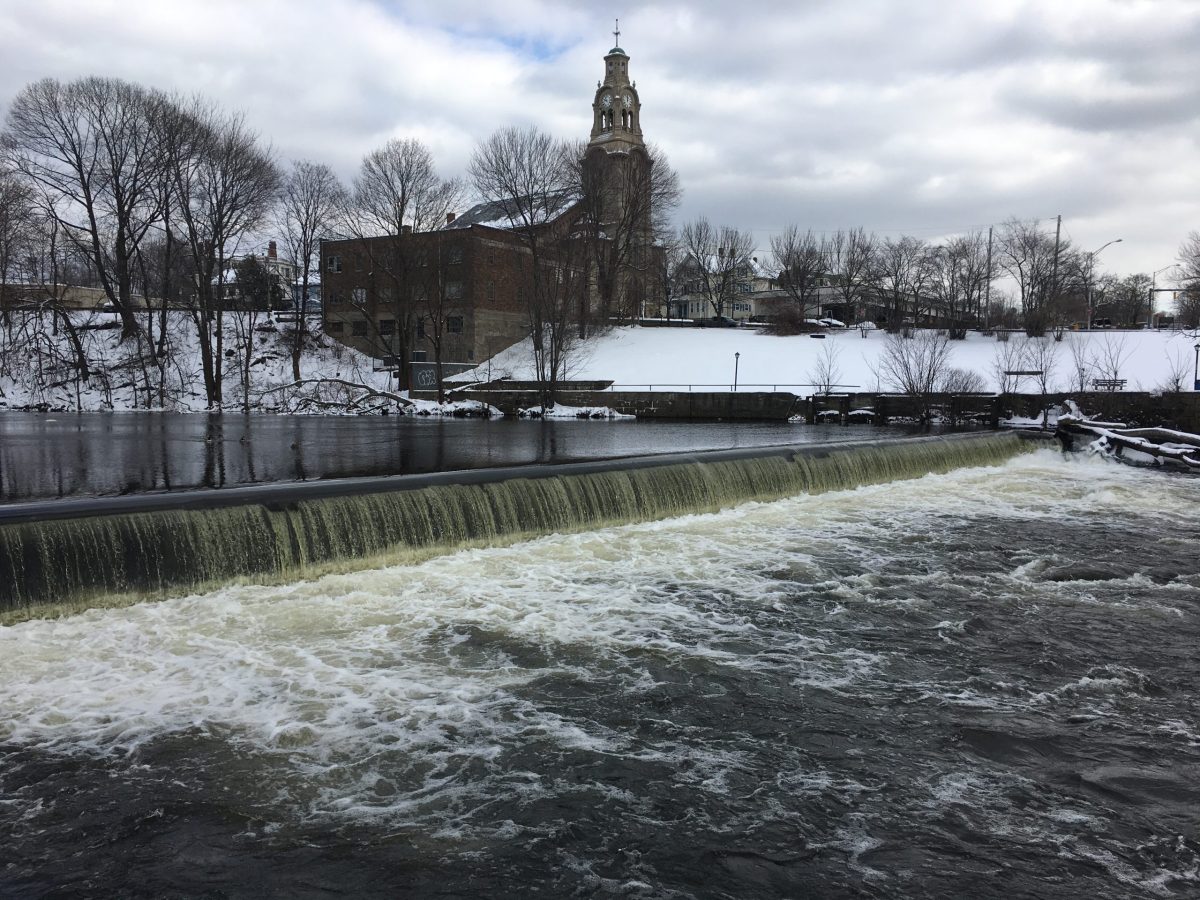
Pawtucket resident Linda Dewing is taking her daily walk around the Blackstone River downtown.
“Sometimes the water is glassy enough that you can see Slater Mill completely reflected in it. That’s kind of beautiful,” Dewing said.
It’s freezing outside and the wind is blowing pretty hard during this particular walk, so there’s no reflection of the mill in the water. However, for Dewing, the walk is still enjoyable.
“I love having this kind of wild nature in the middle of the city, I just think it’s wonderful. It’s a rare privilege,” Dewing said.
Dewing has lived downtown right next to the river since 2004 and she loves everything about it. The river’s flow is peaceful and calming, and she’s able to watch different types of birds in the area.

But just about 40 years ago, the Blackstone wasn’t as appealing.
“You wouldn’t want to be next to the river in the 70s. I used to the work downtown and it was pretty nasty out there,” Mike Cassidy, part-time planning consultant for the city of Pawtucket, said.
Cassidy said at the time, you could see foam falling over the Slater Mill waterfall.
“And it just smelled like a rotten sewer because that’s what it was being used for,” he said.
Since then, wastewater management has gotten a lot better and there isn’t any foam or sewer smell anymore. Environmentalists have also lead efforts to clean out pollutants in the Blackstone, like tires, cars and shopping carts.
Today, people in Pawtucket can cast their boats and fishing lines off of Festival Pier farther down the river, or attend an annual dragon boat racing event.
They can also live or work in restored textile mills along the Blackstone, just like Linda Dewing does, and each mill generates hundreds of thousands of dollars in property taxes.
“Those people are bringing renewed value to the city because businesses are going to want to be supported by the people that live here, the new residents,” Bob Billington, president of the Blackstone Valley Tourism Council, said. “That’s going to start to change the complexion and make our quality of life and enjoyment that much more viable.”

Cassidy said the city’s future plans for the river include redeveloping old properties on either side of it.
A few years ago, the city also developed a Tidewater Master Plan with National Grid for 15 acres of riverfront property. However, there hasn’t been any construction yet.
A huge blow, Cassidy said, was when the city lost the Paw Sox stadium. He said that project was the city’s focus for the past two years, and now they’re back to square one.
“We certainly got plans that it’s easy to build on, we got it all ready to go, we just need a developer and a project and somebody with the will and the money to actually want to do that,” Cassidy said.
Another hurdle for city officials has been completing a bike trail along the river that connects Worcester to Providence. The project is more than 30 years in the making, and in Pawtucket, only two out of the eight sections have been completed.
“At the pace that we’re going, using what we’ve accomplished as the gauge, we would be almost 100 years before the bike path would be complete.”
Billington, who’s been a part of the project’s planning process, said he knows of people who moved to Pawtucket in anticipation of a new bike path. However, he thinks the trail won’t be finished for a very long time.
“At the pace that we’re going, using what we’ve accomplished as the gauge, we would be almost 100 years before the bike path would be complete,” Billington said. “It’s an absurd statement, but when you do the numbers, it’s not so absurd.”
So what’s the hold up?
“It’s a matter of the will of the people and the leaders to just focus in and say this is what we need to do,” Billington said.
Cassidy said the bike path plan has faced delays because of opposition from property owners concerned about cyclists riding by their backyards. It has also been mired in a lengthy permitting process because Rhode Island’s Department of Environmental Management has stricter contamination standards for recreational projects than they do for commercial ones.
“When you’re inviting people to come in and travel along a recreation area where there’s paved area and a greenway, the kids can get at the soil so you have to protect them and make sure that you’re putting a couple of feet of clean soil wherever they might get access to it,” Cassidy said.
Cassidy said he’s hoping Rhode Island’s portion of the bike trail will be done in the next 10 years.

Meanwhile, as city officials work on planning and redevelopment, environmental groups are continuing to clean up the Blackstone since the river is still too dirty for people to swim and eat the fish from it.
“We thought that we would be able to make it fishable and swimmable in 2015, but you know, sometimes you have to go back a couple of steps before you move ahead,” Arthur Plitt, director of the nonprofit Friends of the Blackstone, said. “It’s sad that we don’t have it as we like it, but it’s getting better and better, but that’s what we hope, that more people will take advantage of it and flock to these places to have healthy recreation.”
Back in Pawtucket, Linda Dewing points out Pawtucket Falls. It’s the spot where the Blackstone meets Narragansett Bay.
Dewing likes it here, and she’s hoping more people in the future will be lured in.
“I want the river just to feel part of the town and for people to say, ‘Oh, isn’t this great, we can walk along the river, we can see the river, or we can watch the ducks, or we can feed the ducks, or we can play rubber ducky,’ or whatever the level is,” Dewing said.
Well, it turns out, cities across the country are reclaiming their rivers to do just that.

“These days it’s pretty common in city planning to see water as a highly prized amenity, and the closer you can get people to the water, the better,” Robert Azar, deputy director of the Department of Planning and Development for Providence, said.
Azar said getting people closer to rivers enhances their quality of life in a city.
“In an urban setting, I think there’s a beautiful contrast between the heavily built up city and the undeveloped water. It’s a little bit of the wild in the middle of the city,” Azar said.
Azar used Providence as an example, saying there wouldn’t be nearly as much development downtown as there is now if it wasn’t for the improvements made to the riverfront.
Pawtucket’s riverfront is still a work in progress, but it is progress. It’s cleaner, more people are living by it, and, although it’s taken decades, it does seem plans for a bike path and other riverfront development are slowly but surely moving forward.