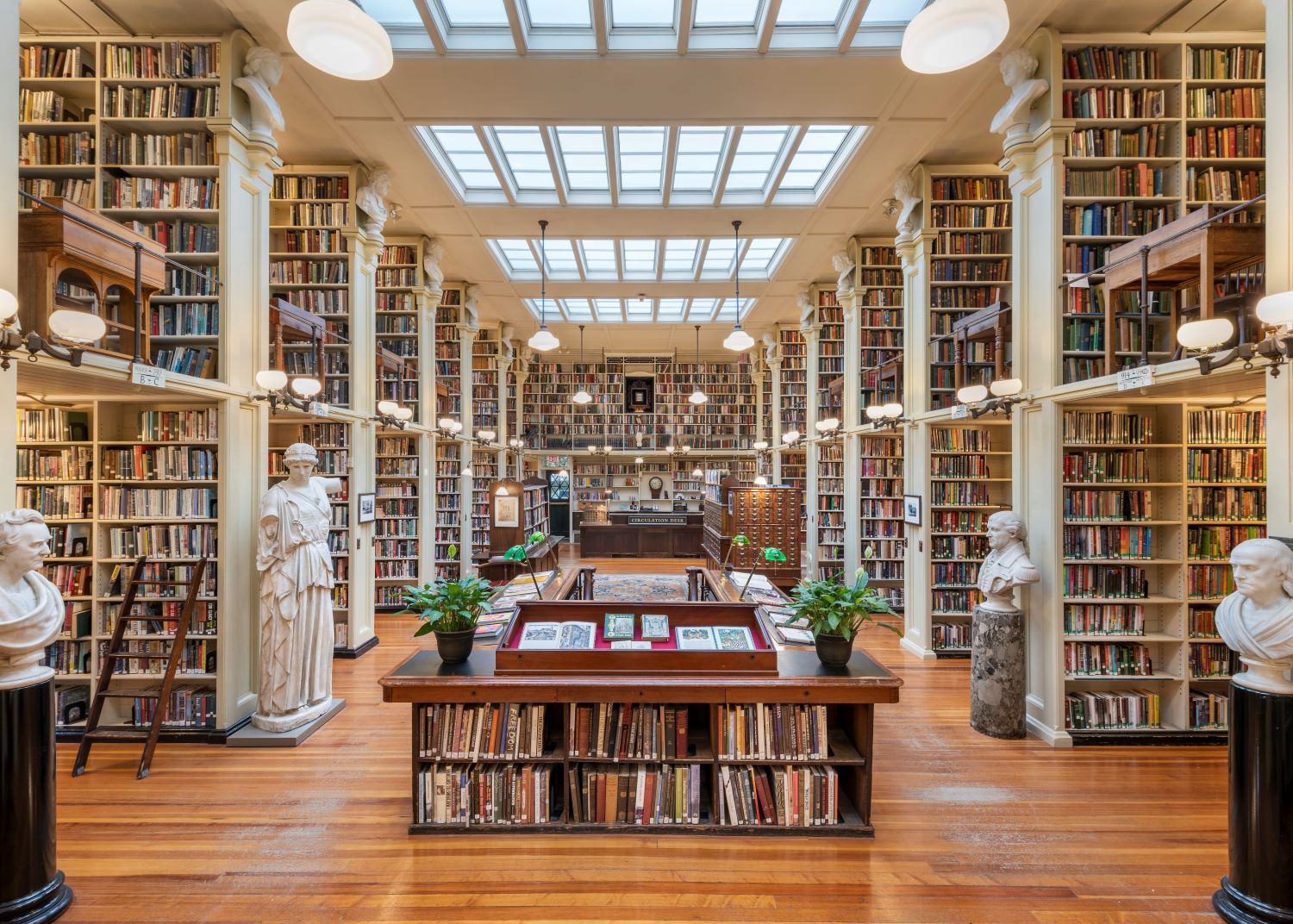

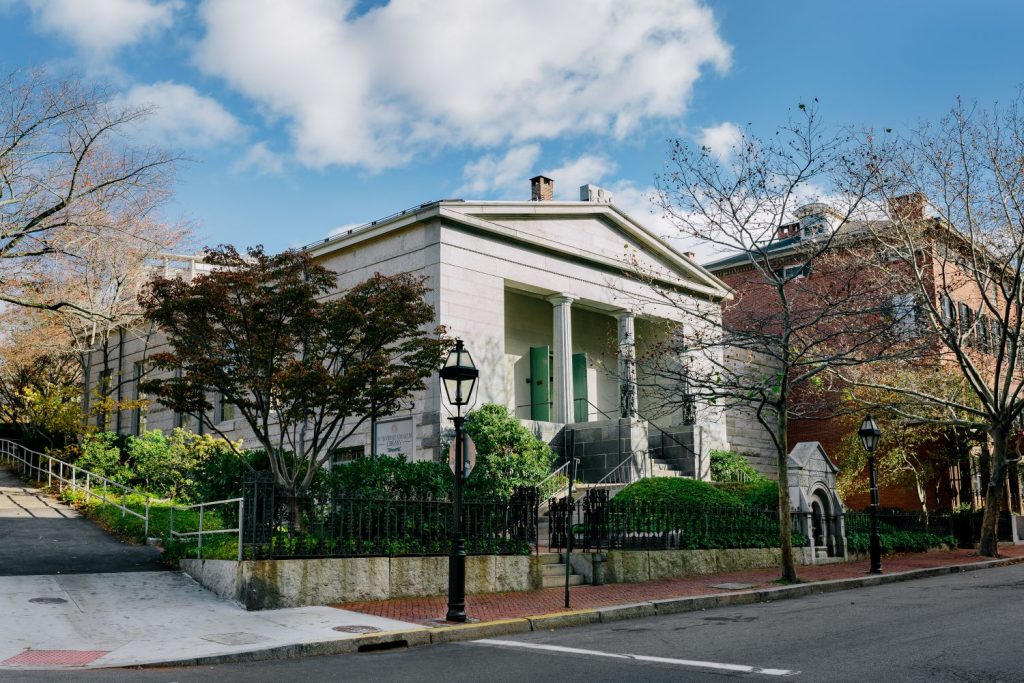
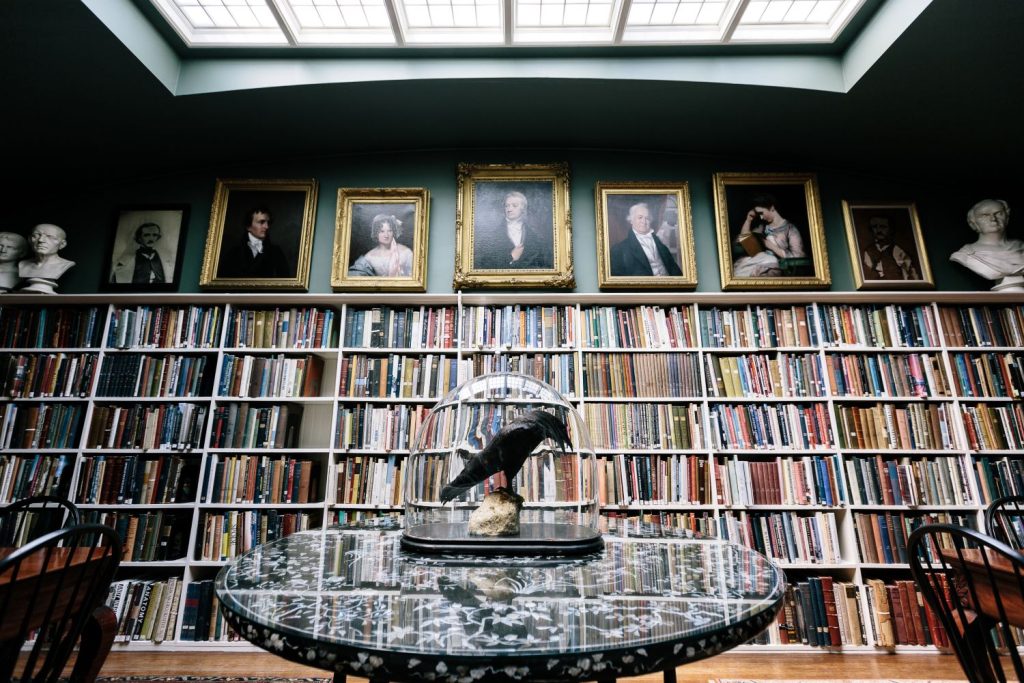
The first time I walked into the Providence Athenaeum, I was taken aback by its grandeur. It looks like a classical Greek temple on the outside, with a high ceiling inside that reveals what appears to be endless rows of books.
“When people first walk up the granite staircase into the temple, they usually just stand in awe of everything that they see around them,” said Kate Wodehouse, director of collections and library services at the Athenaeum. “The books that line from floor to the ceiling, and the artwork. And it’s just a magnificent scene, and it contrasts with the exterior of the building, which can be sort of cold and austere. But it’s a really warm, welcoming place, and like nearly everyone says to us that comes in, it’s what a library should look like.”
All around the place, often hiding in plain sight, are fascinating pieces of art and history. I asked Wodehouse to show me some of the artwork and books in their special collections. We started upstairs with a tiny painting that’s just three-and-a-half by five-and-a-half inches.
“It’s a tiny little sliver of ivory, and hand painted with watercolor,” she said. “It’s painted by Edward Malbone, who was a well known Newport artist, and he painted it in 1801.”
It’s called “The Hours” and it depicts three women in delicate robes with curled hair. Edward Malbone died young of tuberculosis, and his sister tried to sell the painting to the Athenaeum for $1200. But the library couldn’t afford it.
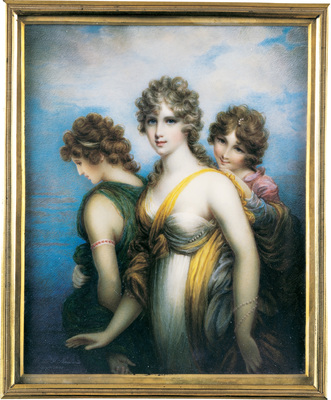
“A young teenage daughter of one of the board members overheard her father speaking about this, and her name was Eliza Patton,” Wodehouse told me. “And she decided that she would take it upon herself to raise the money to acquire the painting, because she wanted it to come here to Providence and be in the Athenaeum. So her father sort of laughed at her but she was dogged and determined, and she took the painting, carried it in a little green felt bag, and went door to door around Providence collecting money. Her mother said, ‘if you manage to collect $1000, I will contribute the last $200,’ which she did. And the painting came to us in 1854 and has been in this elaborate walnut carved case ever since.”
Next, Wodehouse took me to a small room, bathed in natural light, with shelves of books and several portraits. Two of the portraits are of Edgar Allen Poe, one of the more famous people known to have visited the library.
“He was here in 1848, courting a local poet by the name of Sarah Helen Whitman, who lived down on Benefit Street,” Wodehouse said. “So you can see her portrait up on the wall here. She is wearing a bonnet with pink ribbons streaming down, and that was a portrait taken about ten years before they met.”
While Poe was attempting to woo Sarah Helen Whitman, they would meet at the Athenaeum.
“And on one of those occasions, Sarah Helen Whitman took a book from the shelf. It was a journal called American Whig Review. And she turned to a page, a poem called ‘Ulalume,’ a ballad, and she asked Poe if he knew who had written it because it was published anonymously. And he said he indeed had been the author of it, and he signed his name at the bottom of the page, Edgar A. Poe,” Wodehouse said. “And we know this because she recounts this story many years later to one of Poe’s biographers. And, in doing so, she says she went back to the library to look for the volume, and there it was, almost 24 years later, still on the shelf. And at that point, we took it off the circulating shelves and moved it down to a more secure area, but it’s still here today.”
But romantic encounters over poetry at the library were not enough for Poe to capture her heart.
“I should tell you that they were briefly engaged to be married, but the stipulation from Sarah Helen Whitman was that he abstain from alcohol,” Wodehouse said. “But alas, that was not to be.”
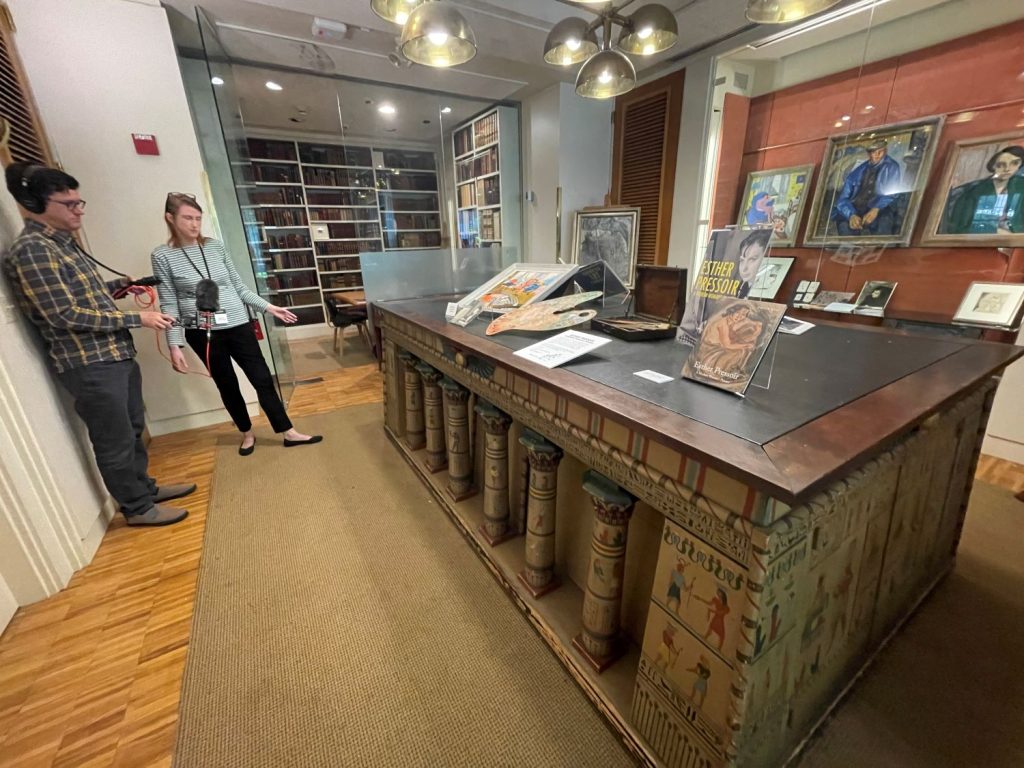
We headed down to the lower level to see the special collections room. As you walk in, there’s a gigantic cabinet decorated in the style of Egyptian hieroglyphics. It was made to hold “The Description of Egypt,” a 25 volume work from the early 19th century created by French scholars during Napoleon’s occupation of Egypt. It’s one of the treasures of the Athenaeum’s rare book collection. Another is a collection of poetry, biographies and criticism of the Scottish poet Robert Burns. There’s also a first edition of Herman Melville’s “Moby Dick.”
“Because our readers are very active, many of our first editions like ‘Moby Dick’ from 1851 is in a bit of a shambles, I would say,” Wodehouse said. “But that’s part of the charm of our circulating collection, because we were buying things at the time that they were being published and they were popular, and they circulated because we are a reader’s library first and foremost.”
I asked Wodehouse if she has a favorite item in the special collections.
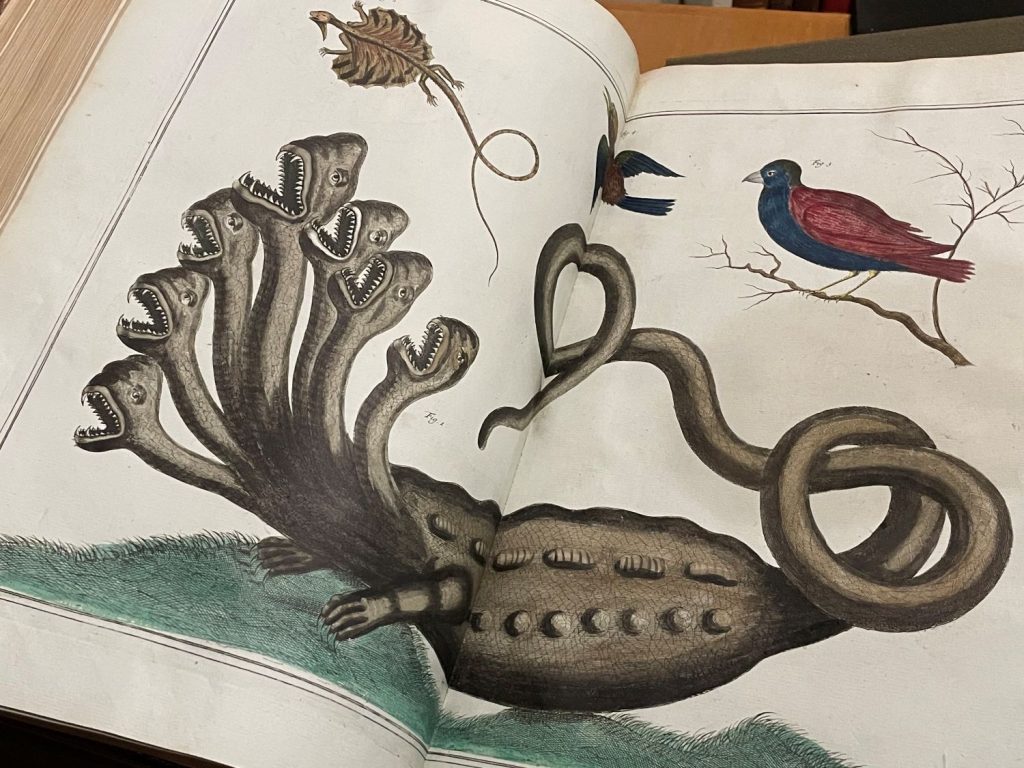
“My favorite item in the collection is Albertus Seba’s ‘Cabinet of [Natural] Curiosities,’ which is a four-volume set that was donated in the early 20th century,” she said “They are large folio, red Morocco leather-bound books with gilt, and they represent an apothecary’s collection of natural specimens that he collected, and it was produced between 1730 and 1760. And they’re beautifully illustrated copper plate engravings, and then all hand colored. And they’re really whimsical, artistic, and that has been my top thing that we have down here.”
Albertus Seba was an apothecary and a gentleman scholar, and in the fashion of the day he had collected many rare plants and taxidermy animals from all over the world. This was his “cabinet of curiosities.” The books were his way of showing off his collection.
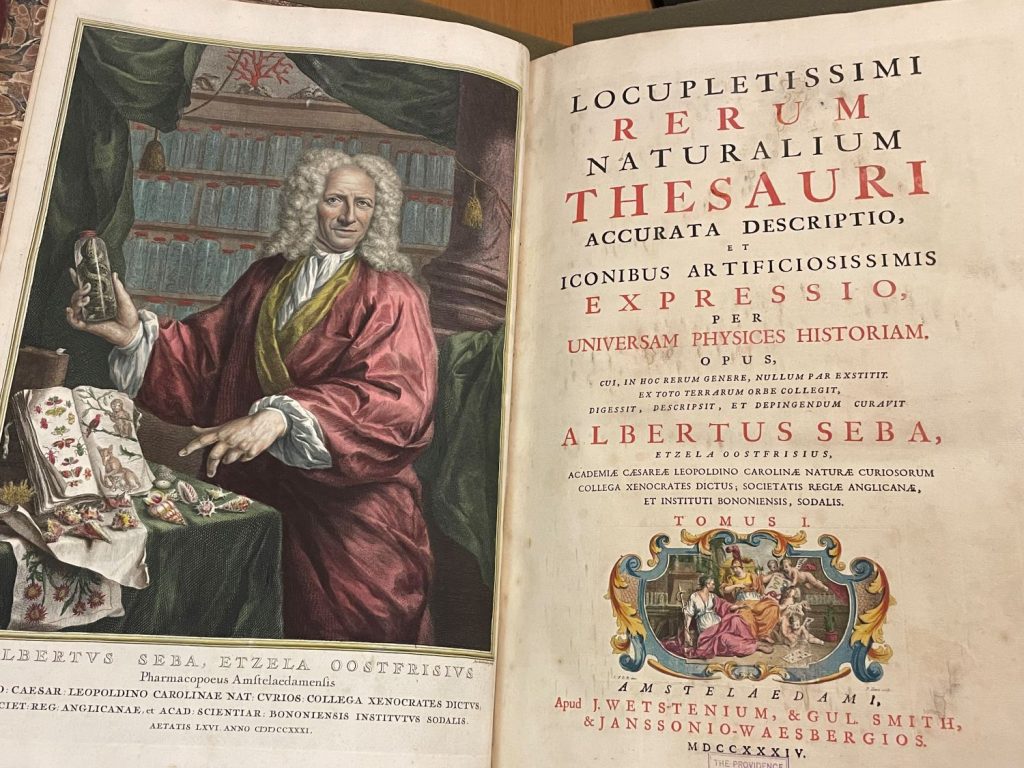
“So here, inside, this one has mostly flora and fauna,” Wodehouse told me. “It’s not a natural scene, but I think they are spectacular. And they’re so colorful, and they’re known more for the arrangement of the objects on the page than they are for sort of scientific integrity.”
There are pictures of animals from all over the world, but many of them don’t look quite right. The monkeys have very pinched faces. There’s some sort of marsupial that has a long, rat-like tail. And then there are some animals that were completely fabricated.
“This is the seven-headed hydra. So this was meant to sort of awe people about the amazing things that Seba had collected, but it is a fraud, of course,” Wodehouse said. “And an item like this was sold by someone – I can’t remember exactly where off the top of my head – but it’s parts of different animals stitched together. And it’s the kind of thing that, you know, you would marvel at, at the time.”
Reproductions of “The Cabinet of Curiosities” are now on display. You can find more information at ProvidenceAthenaeum.org.