
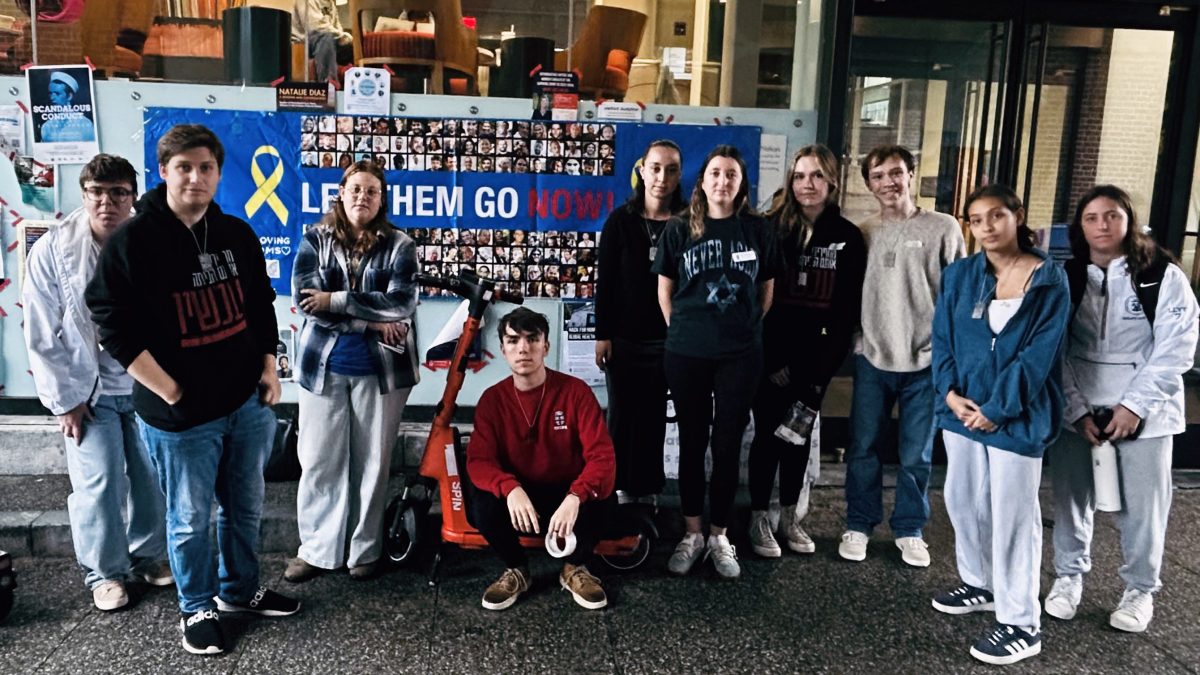
On the one-year anniversary of the Hamas-led attacks in Israel — the deadliest day in the history of the country — a group of students from Brown and RISD stood in the rain hanging an installation in honor of the October 7th victims. Members of the Brown RISD Hillel, they wanted to mark Monday’s somber occasion.
The attacks left more than 1,200 dead in Israel, and sparked a wider war in Gaza, in which more than 40,000 have died. In Providence, and thousands of other communities across the globe, the events of the tumultuous year have been top of mind for many. Hundreds of pro-Palestinian protesters marched through Providence over the weekend.
Rabbi Josh Bolton, executive director of Brown RISD Hillel, said the students he works with process the events in different ways. Some of the students are grieving, while others want support for pro-Jewish or pro-Israel advocacy work.
“I think that there’s still many, many students who are still trying to understand the meaning of October 7th,” Bolton said. “There’s the notion of ‘October 8th Jews:’ That the day after October 7th, many, many Jews across America on campuses and elsewhere woke up to a sense of their Jewish identity and their Jewishness in a way that they perhaps had not yet ever felt before.”
Bolton spoke with The Public’s Radio Afternoon Host Dave Fallon about how his campuses are marking October 7th.
This transcript has been edited for length and clarity.
Dave Fallon: First of all, how are you marking this very somber occasion today?
Rabbi Josh Bolton: Listen, you know, personally, this story hit my family in a very, very, intimate and private manner. My wife’s first cousin, Anya Leesman, was one of those who lost their lives at the Nova Dance Festival at Kibbutz Re’im on October 7th.
So I think that personally, the day calls to memory those kind of initial shocks of news and communication between family members. So, it’s — you can feel it rattling very, very deeply in the soul.
Fallon: I am sorry for that loss. How, in your position, do you separate that in counseling others?
Bolton: You know, this is one of the great privileges of this work to accompany students. And to grieve alongside them, to learn with them, to support them, to be there as a presence. You know, the fact of the matter is I can’t be more proud of my Hillel colleagues here at Brown, RISD, and around the country who from October 7th until this October 7th have really stepped up in ways that are superhuman and have, they’ve been on the front lines of the really complex process.
The cultural moment that we’re living through — they’ve done it with grace, and they’ve done it in a way in which they’ve preserved their kind of sense of their own story and their own well-being alongside, you know, really stepping up on behalf of students in extraordinary ways.
Fallon: Rabbi, with this new semester beginning, what are you hearing from students as they process today’s anniversary?
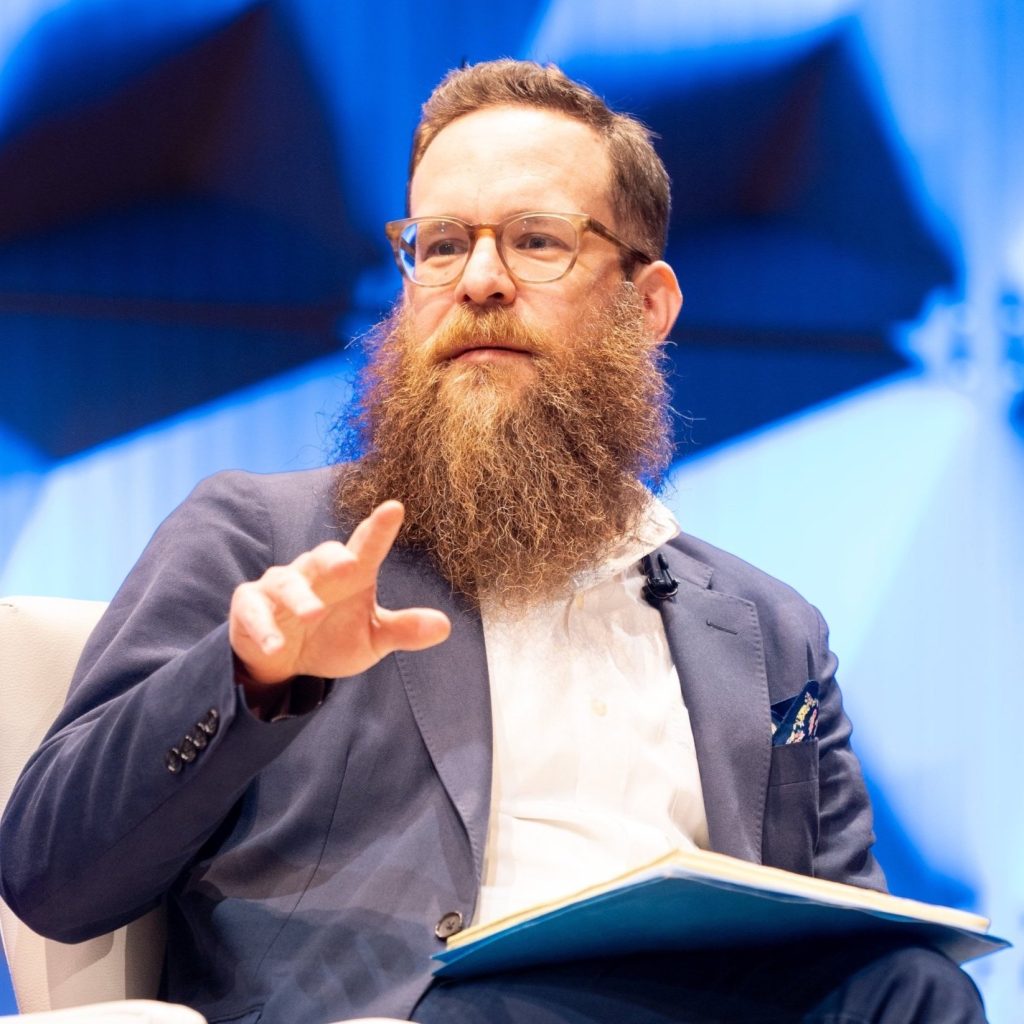
Bolton: I think that today, students are in need of all sorts of support. You know, some students are grieving. Some students are holding very close the memories of loved ones, family, friends who were lost over the course of the past year, whether on October 7th or in the course of the war that has extended.
Some students are seeking support for their advocacy work. And, you know, I cannot be more proud of the dozens of students who, through the rain of this morning, set up installations, memorials, spent an hour reading the names of those who have been lost over the past year and, you know, who have really been stalwart advocates, pro Israel, Zionist students in the midst of an ecosystem that has been pretty complicated and sometimes pretty nasty towards them.
And I think that there’s still many, many students who are still trying to understand, you know, about the meaning of October 7th. There’s the notion of October 8th Jews, that the day after October 7th, many, many Jews across America on campuses and elsewhere, woke up to a sense of their Jewish identity and their Jewishness in a way that they perhaps had not yet ever felt before.
Fallon: Let me ask, as the questioning and the thinking about these events and these values continue, protests and counter protests in the college community, how should that be handled? In terms of respecting other opinions, and the right to express them publicly.
Bolton: Yeah, I think that universities often get pegged as responsible for this. But what I see happening here at Brown or at universities across the country is really reflective of what we see in the broader social political ecosystem in which we live. And that is that this is a time in which folks prefer to live in Ideological silos.
They prefer to hold up with friends and neighbors who see the world similarly. And which I think is of course, one of the great losses because of the university, almost the spiritual promise of the university is that we’re able to come together, to learn with one another across difference, to acknowledge what we don’t know as much as to profess what we do know.
That has been one of the great wounds, I think, of the past year. But I also want to say that the past seasons have been very, very difficult for Jewish students on campus. It’s my sense that one of the shifts we’ve seen is in language and in terms of permission that has been given to say extraordinarily painful things about Zionists, about Jews.
Fallon: And you speak from a personal experience, I understand.
Bolton: It’s true. That’s right. I mean, you know, both in terms of my support of students, but also I was on the receiving end of death threats that were investigated by the FBI. And we’ve had a number of incidents here.
Fallon: As we wrap up the discussion, what are your immediate hopes for what comes out of this process of observation of the anniversary and discussion about it?
Bolton: Well, we’re going to continue to build a diverse, resilient, creative Jewish community here on campus. And you know, as a foundation to that, we — as I shared before, we recognize that Jewish life brings with it innate joys and inherent “oys.” And that’s Jewish history and we’re going to make sense of it with time.
And in the meantime, we’re going to continue to build, we’re going to continue to create opportunities for students to grow and to learn and to connect. But I don’t think that there’s any doubt that the violence that has been brought upon the Jewish community — it has spurred much more Jewish growth, much more Jewish engagement than its opposite. And that is a source of great optimism for us.