

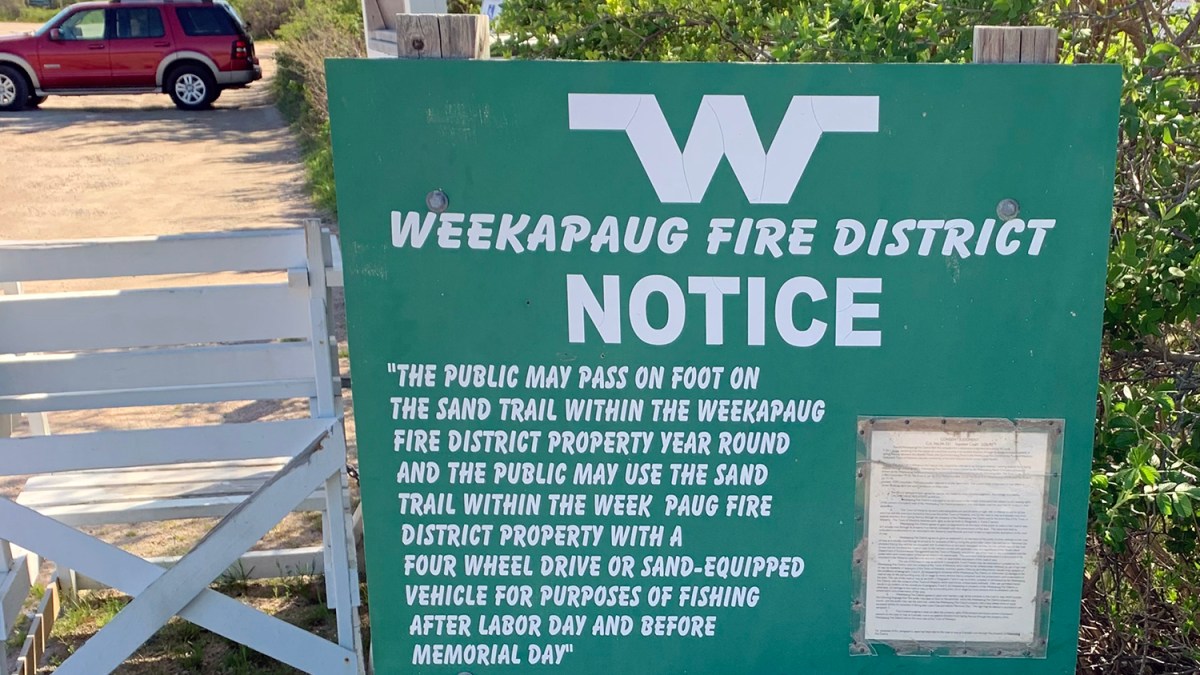
A Rhode Island Superior Court judge has dismissed a motion by the Weekapaug Fire District to hold the town of Westerly in contempt of a 1997 agreement between the town and fire district that governs the use of the Sand Trail at the Quonochontaug Barrier Beach.
The Sand Trail runs down the middle of the barrier beach peninsula and is used by fire district residents and guests to park and access the beach. In parts, it’s a bumpy dirt road, and in other sections it’s a sandy path that can only be driven on with four-wheel drive vehicles.
In March, the town of Westerly referred the Sand Trail to the Rhode Island Coastal Resources Management Council for consideration as a state-designated right-of-way to the shore.
That triggered a motion by the fire district, which argued that the town had violated the so-called consent judgment.
The 1997 agreement resolved a dispute over who had control of the Sand Trail, named the fire district owner of the land, and spelled out allowable public uses of the Sand Trail, like walking, and driving four-wheel drive vehicles in the off-season. Much of the beachfront land bordering the Sand Trail is owned by the Weekapaug Fire District, and public access there is restricted.
According to the fire district’s recent motion, the 1997 judgment “fully and finally, and unequivocally, settled and resolved the ownership of the Sand Trail and the use thereof,” and the referral to CRMC in March “directly challenged” the agreement.
But Town Solicitor William Conley revealed in court Friday that the request brought to CRMC in March is no longer being reviewed. After hearing that, associate Justice Sarah Taft-Carter denied the fire district’s request to hold the town in contempt of the agreement.
The Sand Trail is still under consideration before CRMC, because it was referred to CRMC by the town solicitor in 2020, which he now says was an error. A spokesperson for CRMC said Friday that the two files have been consolidated into the 2020 docket.
Members of the Westerly Town Council say their March request was to confirm the town’s desire to see the state consider the merits of a public right-of-way at the Sand Trail.
The Town Council of Charlestown has also voted to formally ask CRMC to consider the Sand Trail as a possible public right-of-way. The end of the Quonochontaug Barrier Beach is located in Charlestown, and that municipality is not a party to the consent judgment between Westerly and the fire district.
Farside, the fire district attorney from the national law firm Locke Lord, argued Friday that the motion to hold the town in contempt of the 1997 consent judgment also makes reference to the 2020 referral, which triggered the case file that remains open.
But Justice Taft-Carter said her reading of the motion is that it “clearly refers” to the March 2023 Town Council resolution.
Farside criticized the town for not sharing the news that CRMC closed the 2023 docket until the last minute, saying, “It’s crazy to me.”
“I didn’t like that tone, counsel,” Taft-Carter said. “My order is your request is denied.”
Farside said he would not comment when approached by a reporter after the hearing. Conley immediately went into a conference room with two associates after leaving court.
In addition to the Sand Trail case, the Weekapaug Fire District is fighting to keep another right-of-way from being designated a public path to the shore. That right-of-way, Spring Avenue, is currently blocked by a fence and overgrown vegetation, and the fire district claims it’s the rightful owner of the land.
The Rhode Island Attorney General’s Office has become formally involved in that case before CRMC on behalf of the public. Another lawyer, retired Rhode Island Assistant Attorney General Mike Rubin, is representing a client from Westerly, arguing Spring Avenue should be opened for public use.
The Weekapaug Fire District expects that case will result in more than $300,000 in legal fees for the district in 2023 alone.
Alex Nunes can be reached at anunes@thepublicsradio.org